
The Problem
Fragmented sales channels leading to inconsistent customer data. Telecom operator had legacy monolithic systems that couldn't scale, causing customer experience issues and data inconsistencies across regions.
The Solution
Led the architecture of a modular microservices platform on Azure, integrating Apache Kafka for event streaming and Salesforce for customer data. Implemented domain-driven design with independent deployment capabilities.
Microservice Architecture

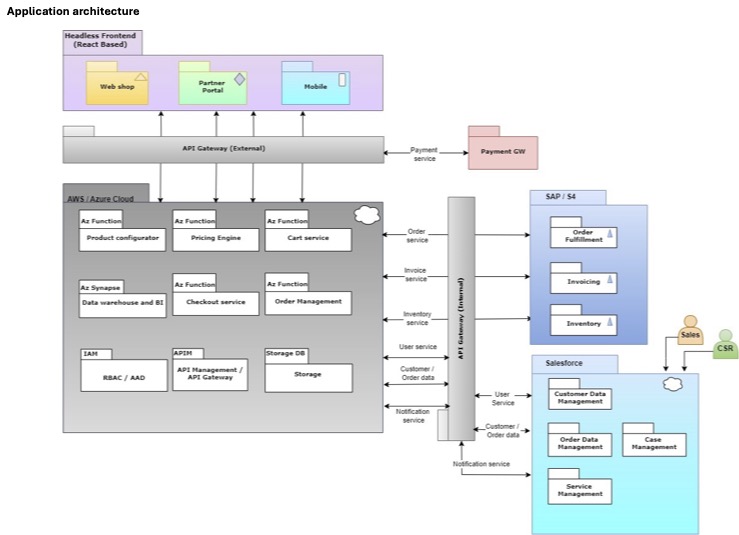
Application Architecture
Tech Stack
Azure, Apache Kafka, Salesforce, Microservices, SAP S/4HANA.
Serverless Computing
Azure Functions / AWS Lambda Responsibilities (Microservices-Based Approach):
- Cart Service: Serverless functions manage cart updates, session persistence.
- Pricing Engine: Calculates discounts, taxes, and promotions dynamically.
- Checkout Service: Handles payment authorization and transaction logging.
- Order Management: Processes order workflows, syncs with ERP (SAP S/4HANA).
- Product Configurator: Provides real-time custom product configuration.
- Integration: Two API gateway layers one external connection (like Web portal, Partner portal, Mobile, Payment GW, etc.) and the other is for internal connectivity internal components (like Salesforce, SAP, Storage, etc.)
Salesforce Sales & Service Cloud Responsibilities:
- Sales & Order Management: Sales reps interact with customers, track opportunities, and manage service cases.
- CRM-Driven Workflows: Orders synced with Salesforce for tracking, customer insights, and after-sales support.
- Customer Interaction Data: Logs inquiries, cases, and escalations related to orders.
- Service Management: Service Cloud handles warranty claims, service requests, and support ticketing.
Impact
- Unified the sales experience across 10+ global regions
- Reduced system latency by 70%
- Enabled autonomous team deployments
- Increased customer onboarding speed by 5x
10+
Global Regions
70%
Latency Reduced
5x
Faster Onboarding